Prepared by Sue Campbell and Dr Clare McFeely, School of Medicine, Dentistry and Nursing
This session has been carried out with a number of different student groups – student nurses as part of a leadership and management module; Advanced Nursing Science and Health Services Management Masters students as part of a global health module; undergraduate nursing students in Singapore as part of a health and social policy module.
Brief summary of the case study
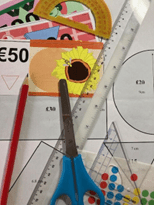
The aim of this game is to help students understand the impact of socioeconomic inequalities on the ability of countries to operate in global systems. Students are divided into groups, are given varying resources, with each group representing a country. They compete against each other to manufacture shapes made from paper which are sold to a commodity trader at fixed prices. The aim is to make as much money as possible for their country.
Preparation
The resources for each group are placed in a folder/large envelope. This can be two groups for each region:
| High income country | 2 pairs of scissors; 2 rulers; 1 compass; 1 set square (the exact size of the large triangular shape); 1 protractor (the exact size of the semi-circular shape); 2 pencils; 1 sheet of A4 paper; 6 × £100 notes |
| Middle income country | 2 pencils; 1 ruler; 10 sheets of A4 paper; 3 × £100 notes |
| Low income country | 2 pencils; 4 sheets of A4 paper; 2 × £100 notes |
Ref – https://www.economicsnetwork.ac.uk/showcase/tradegame_resources
Put up posters on the wall showing the shapes, their measurements and their initial values. These posters are enlarged to A3, so that students cannot trace out the shapes. Links to the shapes poster is here: Microsoft Word format Requirements for the commodity trader is available here envelope for the commodity trader and the game leader is available here envelope of resources for yourself.
The role of the commodity trader
One person will be the commodity trader. This can be a student or an extra staff member. The commodity trader exchanges money for the shapes ensuring that the price is what the game leader has said. The trader should reject shapes which are not the correct size or do not conform to other production standards such as smooth edges.
Carrying out the activity
The game can be run over 45 minutes with 15 minutes for debriefing at the end. The classroom needs to be an active learning space so students can sit in groups round a table. A minimum of 15 students and ideally no more than 40 students is suitable. For larger groups you can run this as two ‘worlds’ splitting the room in half. Groups of 3-6 works well. High income countries can have more students in the group.
| Time | Game leader task |
| 00 minutes | Starting the game – distribute the envelopes to each group. Read out the instructions. See here for instructions – https://www.economicsnetwork.ac.uk/showcase/tradegame_intro |
| 15 minutes | Announce a paper auction will be held in 3 minutes |
| 18 minutes | Auction 2 pieces of paper, then 3 pieces of paper, then a single sheet |
| 20 minutes | Announce scissor auction will take place in 2 minutes |
| 30 minutes | Announce price change – circles now £10; Set square £100; Rectangle £150 |
| 37 minutes | Inform one high income and one middle income country that shapes with a sticker on will increase in price by 3 fold. |
| 42 minutes | Notice of end of trading in 3 minutes. At one minute stop anyone else from joining the queue. |
| 45 minutes | Final whistle |
Post activity discussion
A starting point for the discussion can be asking how did it feel to take part in the activity; if you were in a high resource group how did you feel? If you were in a low resource group how did you feel?
At the beginning of the activity students generally don’t realise that not everyone has been given the same resources. This is discussed in terms of the challenges of being able to negotiate on the world stage when it isn’t a level playing field. This also links to ideas around value chain analysis and the worth of raw materials.
Did the group with the highest number of resources at the start acquire the highest sum of money at the end of the game?
Rarely do any groups consider working together and pulling their resources – but this may have happened when the purpose of the sticky dots was known. Discussions could take place on delegations attending major conferences such as COP. Are countries equally represented? Do those from low income countries have time or resources to attend?
Discussion often focuses on issues around fairness or cheating. This leads to discussions on who makes the rules on world trade and who holds the power. Further discussion can take place on how the students would like the rules of world trade to be? What is the role of UN agencies or the World Bank or the World Trade Organisation? Have the sustainable development goals had an influence on addressing inequalities? Invite students to think about inequalities on a local level. Can people who are socioeconomically disadvantaged work themselves out of poverty?
Did any of the groups try to manufacture shapes without the correct equipment? For example, tearing paper instead of cutting, using one shape as a template. Use this explore adaptations to shortage of resources.
What worked well?
This activity stimulates interesting discussion with all students participating. It is fast, and can get heated, so clear guidance on behaviour is required at the beginning.
References
Further guidance is available here:
Sloman J (2002). The International Trade Game.
World Council of Churches (n.d.) World trade game
 UofGADD